Benqi liquid staking cooldown timing and AVAX access
Benqi liquid staking issues sAVAX tokens representing staked AVAX. Direct unstaking separates the request from the later transaction that returns AVAX. Its documented schedule uses a 15-day cooldown followed by a 2-day claim window. Rewards continue during the cooldown, then stop accruing for that redemption during the claim window. These timing settings are adjustable, so the request's applicable schedule determines withdrawal eligibility.
last updated
On this page
A deadline for spending AVAX must leave room for both the waiting period and the claim transaction. Holding transferable sAVAX provides another exit option through a market, where available liquidity and the execution price determine the amount received.
Available sAVAX and the recorded unstaking request
An unstaking request requires available sAVAX in the requesting account. The contract records the requested shares and their starting timestamp, then holds those shares for redemption. A lower wallet balance can therefore reflect a pending withdrawal rather than a completed AVAX payment.
The request amount identifies the shares entering cooldown. Their AVAX value incorporates the applicable staking rewards through the conversion rate. Tracking only the token count misses that distinction: the same number of shares can represent a different AVAX amount as rewards accrue.
Can AVAX arrive before the cooldown ends?
Direct redemption cannot release AVAX before its cooldown ends, while selling available sAVAX through a market provides a separate route to earlier liquidity.
A market sale requires sufficient liquidity for the intended trade. Its execution price can differ from the protocol's redemption value, and trading fees reduce the proceeds. Transferability therefore provides flexibility without guaranteeing a particular AVAX amount. Shares already committed to an unstaking request are unavailable for a wallet sale while the contract holds them. An unexpired request can be cancelled to return its sAVAX, provided the contract is not paused; selling those returned shares still depends on market liquidity and price.
The timing decision belongs before the request. A spending deadline that falls inside the cooldown cannot rely on direct redemption.
Claim timing follows the request timestamp
The waiting period starts with the recorded unstaking request, rather than the original staking deposit or the moment a browser opens.
Under the documented schedule, a 15-day cooldown precedes a 2-day opportunity to claim AVAX. The claim window begins after cooldown ends; opening the application later does not start another full window.
Both durations are contract settings that administrators can change. For an outstanding request, the contract's applicable cooldown and redemption settings determine eligibility. A remembered duration does not override those settings.
Use the request's displayed eligibility and expiry times when planning availability. An alert near the opening leaves more room for transaction delays than one near expiry. Merely submitting a transaction before the deadline does not establish that redemption completed within it.
A withdrawal deadline before eligibility
Consider a hypothetical reader who holds available sAVAX and needs spendable AVAX within 14 days. Assume the documented 15-day cooldown applies throughout this example.
The reader submits an unstaking request. Its successful transaction records the shares and starting timestamp, and the application shows the position awaiting redemption. That confirms entry into cooldown.
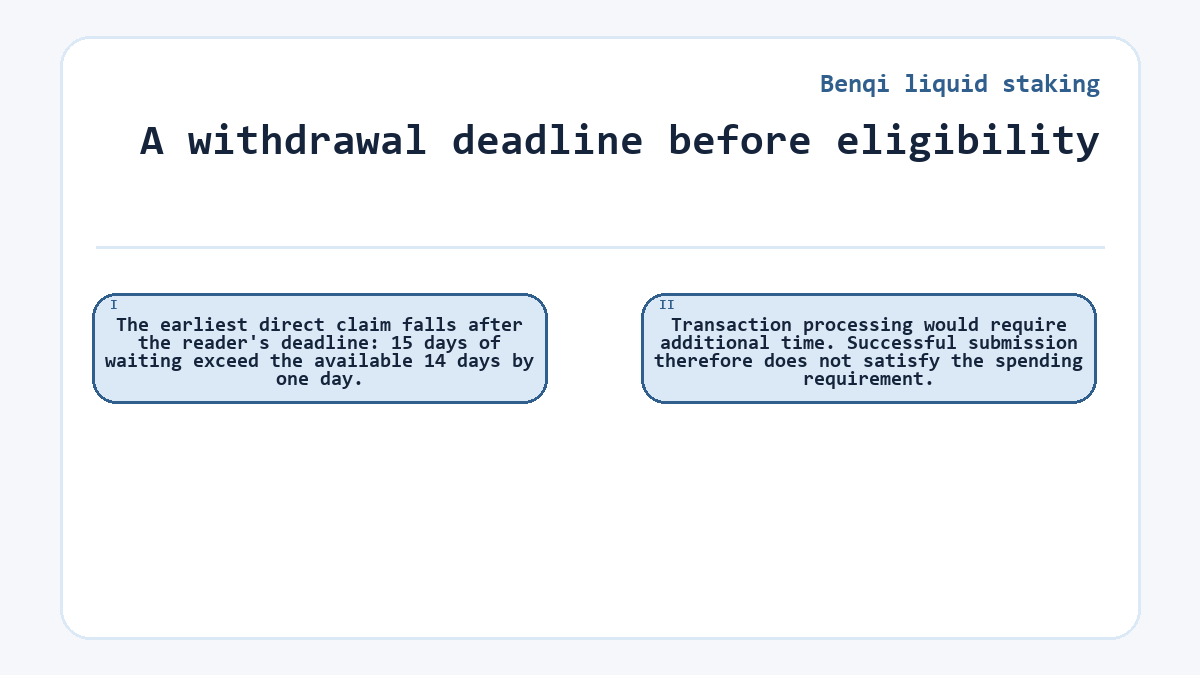
The earliest direct claim falls after the reader's deadline: 15 days of waiting exceed the available 14 days by one day. Transaction processing would require additional time. Successful submission therefore does not satisfy the spending requirement.
An independent comparison of the recorded request timestamp with the claim eligibility time confirms the mismatch. This direct withdrawal route fails the stated deadline even though the unstaking request succeeded. A later spending deadline could change that conclusion; an earlier one would not shorten the cooldown.
Do staking rewards continue while AVAX unlocks?
Staking rewards continue during cooldown, but waiting through the subsequent claim window does not increase the AVAX payout for that redemption. sAVAX reflects accumulated staking rewards through its AVAX conversion rate. The redemption calculation uses the applicable rate associated with the cooldown boundary. A later general conversion rate therefore need not match an already claimable request. Delaying a claim to the final moment adds deadline exposure without extending that request's reward period.
What remains after a missed claim window?
An expired request no longer qualifies for its AVAX redemption window, but its unredeemed sAVAX shares remain recoverable through the overdue-share mechanism.
Recovering those shares returns sAVAX rather than completing the missed AVAX withdrawal. A fresh direct redemption requires another unstaking request and its applicable cooldown. Expiry therefore changes the withdrawal schedule; it does not mean that the original AVAX payment happened automatically.
A deadline reminder cannot execute the claim. Anyone planning to be unavailable during the redemption window needs to account for the required transaction when choosing when to request unstaking.
Claimable AVAX and received AVAX
Claim eligibility means that the timing condition permits redemption. Completion also requires successful contract execution and transfer of AVAX to the requesting account.
The contract must have the required redemption data and sufficient AVAX to complete the payment. A pause or failed transfer can prevent execution even when the time window is open. Repeated submissions do not resolve those conditions and can consume transaction fees.
For reconciliation, the redemption record identifies the paid AVAX amount. The receiving account's native balance also reflects gas costs and any unrelated activity, so its net increase need not equal the gross redemption amount. A failed transaction provides no completed withdrawal to reconcile.
Exit timing for sAVAX used in lending
sAVAX supplied to a lending market introduces a prerequisite before direct unstaking: the account must first regain available sAVAX. Market liquidity and any collateral obligations can constrain that withdrawal. Time spent waiting for the lending position to become withdrawable does not count toward an unstaking request that has not started.
The required spending date should therefore account for every actual restriction on the position. Compare that date with the earliest eligible claim, then allow time to complete the transaction. If direct redemption would miss the deadline, compare the available market liquidity and sale proceeds with the AVAX needed by that date.
Questions and answers about Benqi liquid staking
Does closing the application stop the unstaking countdown?
Closing the application does not stop an unstaking request that the blockchain has already recorded. Its timing follows the recorded timestamp and applicable contract settings. Keeping a browser open does not complete the later claim either; that requires a separate successful transaction during the redemption window.
How do time zones affect an AVAX claim deadline?
Time zones change how a deadline appears on a screen, not when the contract considers a request redeemable. Calendar reminders should use the same instant as the displayed claim deadline. A local date alone is insufficient because it omits the time within that date.
Can separate unstaking requests have different claim windows?
Separate unstaking requests can have different claim windows because each carries its own starting timestamp. Requests submitted at different times should therefore be tracked individually. An earlier request becoming redeemable does not make a later request eligible before its own cooldown ends.
Will a higher transaction fee shorten the cooldown?
A higher transaction fee cannot shorten the cooldown that the contract enforces. Fees concern transaction processing, while redemption eligibility follows the request's timing conditions. Paying more cannot make an early claim valid or restore a window that has already expired.
Where does redeemed AVAX arrive?
Direct redemption returns native AVAX to the requesting account on Avalanche C-Chain. The staking infrastructure handles the underlying P-Chain activity separately. A claim therefore concerns the account's native AVAX balance, rather than an additional sAVAX balance or a manual withdrawal from a validator.
Must the entire sAVAX balance enter cooldown together?
An unstaking request can cover part of an account's available sAVAX balance. The selected amount determines which shares enter that request, while the remaining available shares stay outside it. Later requests for those remaining shares receive their own timestamps and do not inherit elapsed waiting time.